Wednesday, October 24, 2012

Cider Pressing

As I mentioned in my last post, this fall Whitney and I got to take part in my Dad's Apple Cider Pressing Party at the GHJ Tree Farm. It was a beautiful day with friends, family and lots and lots of apples!


Rome Beauty apple

Apple cider has a long history in America and in Europe before that. Often clean water was hard to come by, so apple cider was the common drink. Before beer, hard apple cider was the main alcohol for the common people. In fact according to at least one book that comes to mind (The Botany of Desire) eating apples like the phrase "eat it like an apple" is a fairly new concept, as before that apples were nearly entirely grown for cider. The truth is that Johnny Apple seed was not a health nut apple eater, but much more interested in hard cider! Of course nowadays we know apples are a healthy food and often cider takes a backseat, but the making of cider is still a tradition across the country. Pressing cider is one of the family traditions my Grandfather passed down along with growing Christmas trees and bee keeping. Here is a look at how it's done where I come from.
First off, the apples must be picked. Sometimes you have to get a little creative especially when picking the taller trees! This year on the GHJ Tree Farm, my Dad estimated he picked around 1000 pounds of apples to sell, donate and crush into cider.
After the picking, the apples are sorted (saleable apples are not crushed) and washed. Since all the apples are completely chemical free, the washing is just to get the dust off. Then comes the cutting.  

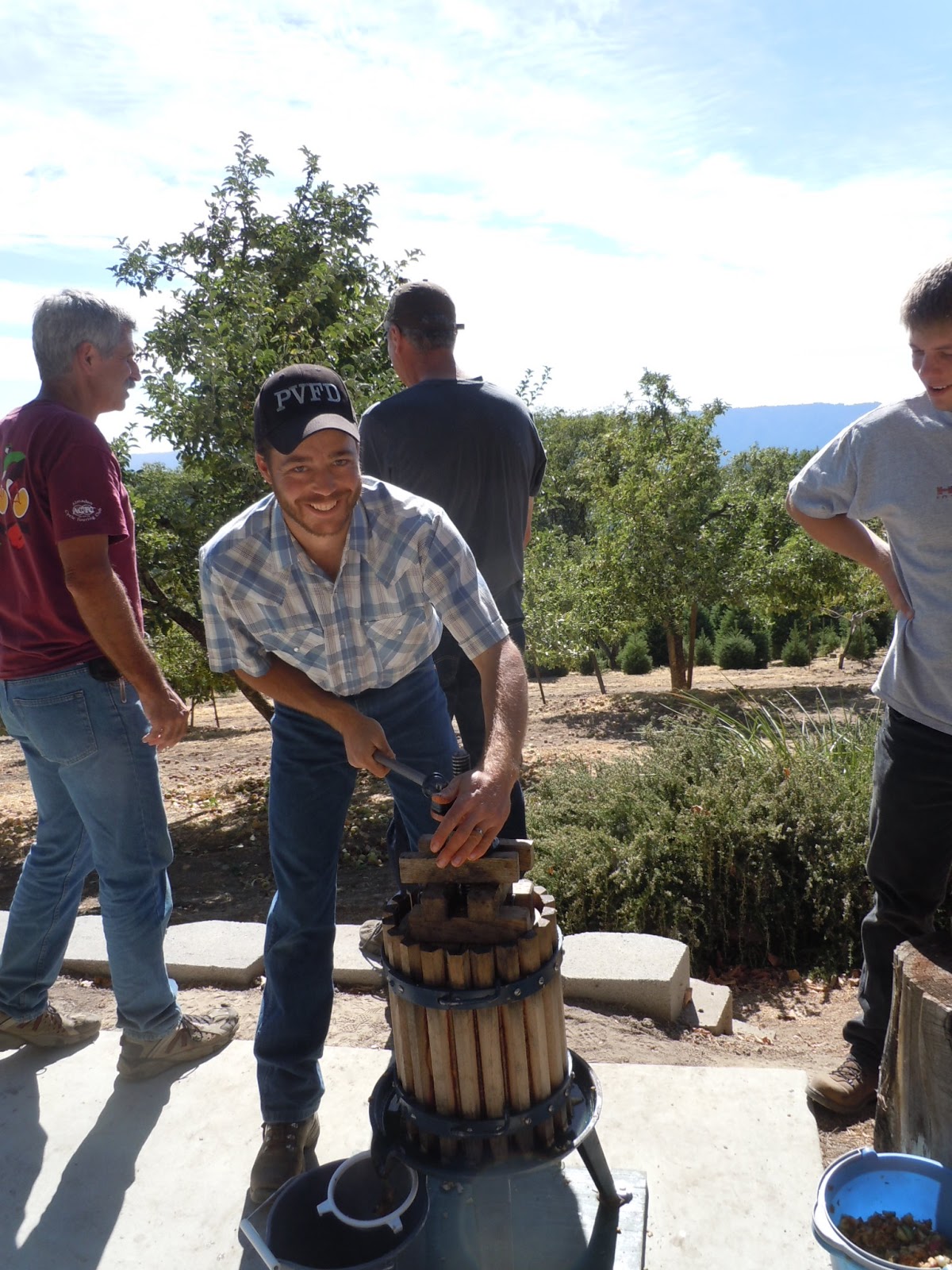
Each apple is quartered and any bad spots removed, before being ground into pulp. The pulp is loaded into the press, and compressed.


Pressing apples in my Grandfather's press.
The juice is filtered, and then poured into jars for the helpers to enjoy and take home.

Fresh Apple Cider
Since the emphasis is place on enjoying the whole process, most of the cider is consumed during the course of the day and we have no good idea how much is made. But one thing I know is everybody got at least a taste and most got to take a few jars home. I think we were guessing we crushed 16, 40lb boxes of apples, so there was plenty of cider to go around. Thanks to everybody that came out and helped make it such a fun event!   So that in a nut shell is cider pressing, if you get a chance sometime give it a try. The taste of fresh cider is beyond delicious.
KJ

Wednesday, October 10, 2012

Our first honey tasting

This Columbus Day weekend Whitney and I had the pleasure of taking part in the 13th Annual, Apple Cider Making Party at the GHJ Tree Farm! It was a beautiful day on the farm in the Santa Cruz Mountains of California where I grew up, and a wonderful time to catch up with family and old friends. It was Whitney's first Cider Making Party, and my first in many years, so it was a truly special day. Look for a blog post all about Cider Pressing coming soon.

While there we had our first (unofficial) honey tasting. One of the reasons I have always been pro honey bee is my good memories of having bee hives and honey when I was young. Years ago my Dad used to sell comb honey at his road side stand along with apples in the fall and Christmas trees in the winter. In more recent times, the bees were maintained for pollination, but not honey. Eventually with the onset of Colony Collapse Disorder and other pests and diseases, the bee hives went away.

Around the same time that Whitney and I became interested in bee keeping, my Dad also decided to return to bee keeping and purchased a package of bees. His first attempt didn't survive, but since then he has been successful, and this year for the first time in many years he harvested honey!

Our honey on the right and my Dad's GHJ Tree Farm honey on the left.
One amazing thing about honey is the variation that can occur between hives. Color, taste and aroma (as well as length of time to crystallize) all depend directly on what plants the bees were feeding on when they filled the comb. Honey truly is a local crop, meaning that what is in the jar is a true representation of what is available within 3 miles of the hive (and often closer when flowers are plentiful). Like ours, my Dad's honey supers were pulled off the hive in the Autumn, so it is a summer honey, as opposed to a spring honey some people extract. Due to our location, our honey is likely a mix of wildflowers, flower gardens and vegetable gardens. It has a full rich flavor, that may come as a surprise at first but is very enjoyable. The GHJ tree farm honey, I suspect has much more wildflowers (weeds) and tree pollens in it due to the remote location. To me this dark amber honey had a light crisp flavor that instantly reminded my of Dad's honey of my youth. To mix things up further, we added a craft third honey, from Snyders Honey in La Honda, CA.

The two Johnson honeys on the right and Snyders Honey on the left.

Again, the light color had no impact on the flavor, which to me was mild and very pleasant, but taste is subjective so one person's sweet is another's mild.
What I do find interesting is that Americans seem to prefer lighter colored honey, so when the big honey houses bottle their batches, they mix it all together and shoot for a nice light to extra light amber like the Snyders Honey above, which is why that's what we are accustomed to seeing in the stores.
Honey colors are expressed in terms of mm according to the Pfund scale, so an Amber like ours has a range of 86 - 114mm, while a Dark Amber like my Dad's is >114mm and an Extra Light Amber like the one of the left is 30 - 50mm. In order to grade honeycolor , one uses a specially tinted piece of glass that has the scale printed on it from light to dark. Source:http://www.honeybeesuite.com/the-color-of-honey/. Does this matter to the honey taster? Nope not a bit, I just find it interesting.
In any case, our first Honey Tasting was a lot of fun, made even more so since we could visit with family while enjoying! Take care everybody, and thanks for reading. KJ

Thursday, September 27, 2012

Welcoming Fall

I heard on the radio one morning this week, it was the first day of Fall. How could that be? It's still 85 degrees! There are still wildfires burning, we haven't seen any rain in months and there aren't even any clouds in the sky! How could it be fall? I was shocked, and yet I started to notice a few things. First off: it was 39 degrees and barely light when I went to work. In the woods I saw leaves turning red, orange, and yellow. Geese are flying south and the elk are bugling. It really and truly is fall in the northwest.
All of a sudden it seems the garden is done and wilted, and the lawn grass is crisp and dead. And, even though I still need more firewood, it's time to start getting ready for hunting season.  Hunting season is a special time for us. Not just because of the meat in the freezer and the chance to pursue game, but more because it is a season, a mindset and a feeling. Now is the time for studying the maps and choosing hunting spots. Should I try a new place or return to an old favorite? It's a time for trying out new equipment bought over the off season and breaking out the stuff I haven't seen in a year (new for this year: an internal frame for the wall tent... SO exciting!). And it's also time to break out the sweaters and slippers. Funny as it sounds, there is great comfort in reuniting with an old flannel after months apart. Best of all, it's time for crock pot dinners and hot toddy's. There is nothing on earth like coming how to a house full of the aroma of a good venison stew cooked all day in the crock pot. Couple that with a fresh baked loaf of bread from the bread machine and you've got a perfect fall evening made to order. Perfect save for one thing. After the stew and bread have been enjoyed to the max, now is time for a hot toddy.
Google it and you're bound to find countless recipes, but for me the perfect Hot Toddy needs only four things. Warm water, Honey, Lemon Juice and Whiskey. Here's how I do it: First off, fill the kettle and place it on the stove. Next, take a good deep mug and pour in a shot (or two) of blended whiskey. Return to the kettle and top off the mug with hot water (not boiling). Add a cap full of lemon juice, and finally a healthy tablespoon of honey. That's it! So nice and relaxing and it's healthy too! A tablespoon of honey every day has many health benefits from soothing sore throats to helping with seasonal allergies. The whiskey may or may not be healthy, but as long as you don't over indulge I doubt it's doing any harm.
With that I'll sign out and wish you all a happy Fall. As a clever guy once told me: "Fall is one of my four favorite seasons".
KJ

Friday, September 21, 2012

The First Honey

 If you remember A bee adventure, then you'll know this day was a long time coming. Over a year ago we decided to give beekeeping a try, after honey bees colonized our porch eaves. In the months since I've posted about the ups and down of learning the trade. Now for the first time, I would dare to call myself a Beekeeper. Last weekend Whitney and I extracted honey for the first time, I guess you can tell I was pretty excited!
A frame of capped honey comb
Honey bees are unique in that they will keep packing away food stores far beyond what they need for survival. A smart beekeeper always makes certain that the bees have enough for themselves, then harvests the extra. Above you see a frame of capped honey ready for extracting. Bees cap the stored honey in the fall and then when it's needed, they chew the capping wax off for the colony to eat.  
Cutting off the capping wax
Before you can spin the honey out of the comb, you must cut off the capping wax to free up the honey in the comb. This wax will get melted and cleaned and Whit plans to try her hand at making lip balm this winter. Stay tuned for that!

frames ready to spin
 The uncapped frames are loaded into the extractor and spun. The spinning forces the honey out of the comb and onto the sides of the exctractor. The honey runs down the inside and pools in the bottom of the extractor.
the very first drop of honey
Eventually the honey pools enough and drops into the filter cloth. This was an exciting moment! Many long  months of reading, researching, hoping and planning, all came down to this. The very very first drop of honey. (que clinking glasses!)

Success at last!
After being filtered, the pure raw honey is poured into jars and capped. There is no heating so the honey remains totally pure and natual and will store indefinately as long as it's kept clean. This first jar was a huge acheivement, I can't even describe how proud I was and still am. Since pure raw honey is actually alive (non-pasturized) it's health atributes are unmatched, but should never be fed to young kids. The color of the honey can vary greatly and is attributed to what flowers the bees were visiting. Since we don't know where every bees went, we'll call ours "garden honey".
After the first jar, the honey kept flowing and we were able to store plenty for ourselves and will have some to sell and give as gifts. All in all this was a huge day for me. All the work and preperation finally paid off. Not unlike my first successful deer hunt, and that first taste of fresh tenderloin. Pure joy and achievement.
Now already I am planning and researching how to over winter my bees so that next spring they are even more healthy, happy and productive!
Thanks for stopping by. KJ

Monday, September 10, 2012

Chicken Integration

If you recall from earlier posts like The halfway house aka chicken tractor and chick love, Whitney and I raised 5 more chickens this year. These Silver Laced Wyandottes came to us as day old chicks and we brooded them in the house until they were old enough to go outside. They lived in the chicken tractor for several weeks while becoming accustomed to the outside world. After they became comfortable, we began opening the door in the afternoons so that the pullets could roam the yard like the hens do. But even though they were all out together, the two groups would not mix. They were two groups tolerant of each other but not interested in meeting. Eventually the pullets became too big for the chicken tractor, so it was time to move them into the coop.
The Five Pullets
I guess I thought Whitney would just chicken whisper them right into the hen house, but it didn't exactly work that way. It turned out more like a game of Chase the Chicken every night for a week. The books all say that it is as simple as placing the pullets in the coop at night, and the next morning they will wake up knowing that's home. I'll tell you how it went for us: One night Whitney and I moved the pullets one at a time into the coop and placed them on the roost. The next morning, when I opened the door to the chicken yard, the pullets tumbled out and hid in the corner. The hens scratched and pecked like normal, but the pullets continued to huddle off on the side. That afternoon we opened the door to the big yard and the pullets ran back to the chicken tractor! We rounded them up and got them back in the coop, but they were clearly not happy about it. For about a week every time we opened the door, the pullets ran out to return to the their old home. It was sad, and we even worried that they might not be eating but after several rounds of chicken wrangling they did start returning to the coop at night. It's taken a while but I'm happy to say that the flock is now fully integrated. Sure the hens have a pecking order and the youngsters are not yet on the top roost, but they aren't a separate flock either.

The Integrated Flock
To top the news, this week Whitney found a couple mini eggs in the nesting boxes, suggesting our little Wyandottes have started laying! So, it's official we've got 19 layers and 1 rooster (although one of the Wyandottes is showing some rooster-like tendencies, more on that later).
Sometime soon we will try honey extracting for the first time, so stay tuned for that.
Until next time, as always, thanks for stopping by.
KJ

Thursday, August 30, 2012

Blue Ribbons!

Around here, the Sanders County Fair is a pretty big deal. Not only is it the biggest thing that happens in our town, it's the biggest thing in the county! 
Whit's award winning Yukon Gold Potatoes
Here, fair is more than just a carnival and fry bread. From the kids with 4H animals, to the Ranch Horse competitions, to the Demolition Derby, the fair is a place to showcase what you take pride in, take part in friendly competition, and possibly take home (or more likely, spend) some prize money.
This year, for the first time Whitney entered  garden produce and crafts, and came away with several Blue Ribbons! In fact, her Yukon Gold potatoes were runners up for Best In Show.
Now before you start thinking this was like shooting fish in a barrel, check out this line up of spuds (bottom row, below). The good people of Sanders County take their gardening seriously! Between late frosts, summer droughts, pests and parasites, growing good looking garden veggies is no accident.
The carrots were also a success in a crowded field.

Whitney did have several items that got second and third place, but in all the eggs, carrots, Yukon Golds, and Sage all got First Place!  

Across the way, in the Arts and Crafts barn, things get even more intense. The quilters, canners, photographers and artists seem to all come out in spades for the fair. So when we saw that a pair of Whit's Peacock feather earrings were awarded a blue ribbon in the jewelry class, we were pretty floored.  
Next year I hope to enter honey and possibly beeswax goods. Until then I'll just have to brag about Whitney's success.  :-)
Take care, and if you get a chance, go to the fair!
 KJ 

Friday, August 24, 2012

Happy Harvesting!


A nice mid-week evening's pick

A bunch of cuc's ready for the sandwich shop. We get lunch deals in return.

Just a quick post to wish you all Happy Harvesting!
KJ