Showing posts with label GHJ Tree Farm. Show all posts

Monday, March 25, 2013

Go plant a tree. You'll be glad you did.

Last weekend I planted an apple tree. Maybe that does not sound like much, but give it some thought.
Planting a tree is one simple act that can have lasting impacts for many years to come. Not only does a tree provide the obvious benefits of shade and fruit (in the case of a fruit tree) but it can also provide countless other benefits. Trees convert CO2 into O2 (that's carbon dioxide into oxygen for the non science types out there). That ability by itself should be enough to make us all stop and say "wow" but there's more. Trees purify water, stabilize soil, provide habitat, feed wildlife, increase soil productivity, store carbon, increase property value, reduce temperature fluctuations, create mulch, provide jobs and fight crime.
Provide Jobs and Fight Crime? Yes, it's true. There are more jobs directly related to trees than the fabled auto industry, and it's been proven by the US Forest Service's Urban Forest Program that neighborhoods with trees have less crime than neighborhoods without trees. Trees are literally leafy green job making-crime fighters. Given that resume, if a tree ran for public office I think we'd all be better off!
The benefits of a tree are hard to realize immediately. In the era of instant gratification, planting a tree is a long term investment. It is a forced slow down. It takes many years for a seedling to grow into a tree. Fruit trees take 3 years or more to bear a crop after planting. But, what you may not see right away are the countless little things that tree is doing everyday. From learning to appreciate the seasons by watching the bud - leaf - bloom - fruit cycle, to reminding you to take a moment and water the trees, trees improve the quality of our lives everyday. One of my favorite things about spring is going out to my little orchard and checking the bud swell. How many more days until leaf burst? Until bloom? Until fruit? In the springtime at work, I am lucky enough to get to check on seedlings I've planted in years past. Conducting survival surveys it's called and it's an activity that can leave me excited and inspired, or downtrodden depending on the results. It's a harsh world for a young tree. The environment is full of hazards from deer and elk to drought to insects and disease, even a late frost can spell death for a seedling. The fact that any seedling makes it to tree is a miracle, but they do.  Both planted and naturally regenerated trees are growing everyday, in fact there are more trees growing in our country today than at any other time in recorded history. A fact that is not without it's downside when you consider overcrowding of our forests and fire hazard - but that's a topic for another post.
I have had the unique opportunity to plant thousands of trees in my life. From a childhood on a tree farm where spring planting was a right of passage, to my education and career as a Forester, to a homeowner with an interest in growing my own foods, I seem to be constantly digging holes for trees. And yet I still love it. To me there are few things more satisfying than revisiting a tree I've planted, and seeing it's growth. So my advice to you is: Go plant a tree. You'll be glad you did.
Counting the days until the bloom.

KJ

Wednesday, October 24, 2012

Cider Pressing

As I mentioned in my last post, this fall Whitney and I got to take part in my Dad's Apple Cider Pressing Party at the GHJ Tree Farm. It was a beautiful day with friends, family and lots and lots of apples!


Rome Beauty apple

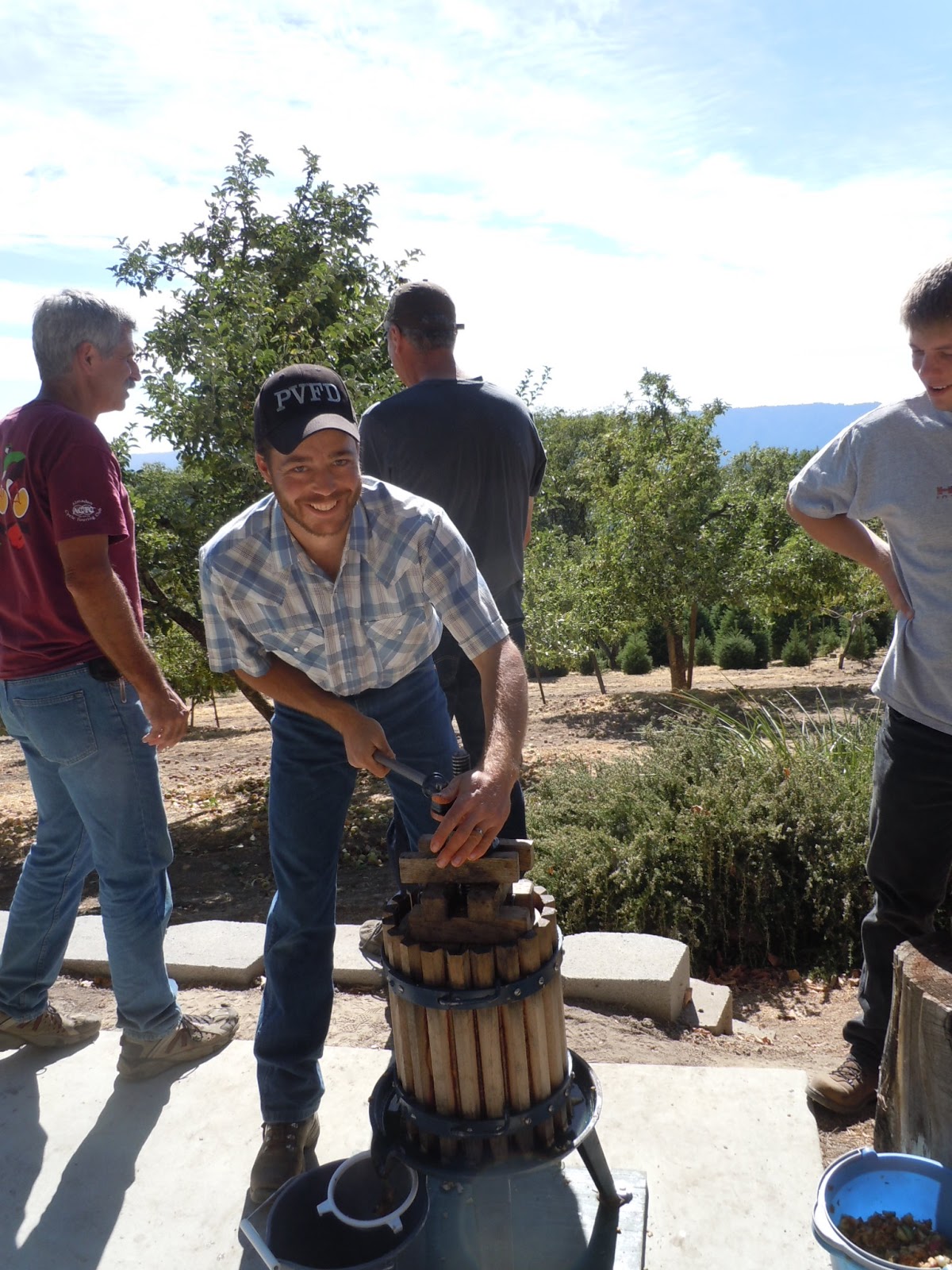
Apple cider has a long history in America and in Europe before that. Often clean water was hard to come by, so apple cider was the common drink. Before beer, hard apple cider was the main alcohol for the common people. In fact according to at least one book that comes to mind (The Botany of Desire) eating apples like the phrase "eat it like an apple" is a fairly new concept, as before that apples were nearly entirely grown for cider. The truth is that Johnny Apple seed was not a health nut apple eater, but much more interested in hard cider! Of course nowadays we know apples are a healthy food and often cider takes a backseat, but the making of cider is still a tradition across the country. Pressing cider is one of the family traditions my Grandfather passed down along with growing Christmas trees and bee keeping. Here is a look at how it's done where I come from.
First off, the apples must be picked. Sometimes you have to get a little creative especially when picking the taller trees! This year on the GHJ Tree Farm, my Dad estimated he picked around 1000 pounds of apples to sell, donate and crush into cider.
After the picking, the apples are sorted (saleable apples are not crushed) and washed. Since all the apples are completely chemical free, the washing is just to get the dust off. Then comes the cutting.  

Each apple is quartered and any bad spots removed, before being ground into pulp. The pulp is loaded into the press, and compressed.


Pressing apples in my Grandfather's press.
The juice is filtered, and then poured into jars for the helpers to enjoy and take home.

Fresh Apple Cider
Since the emphasis is place on enjoying the whole process, most of the cider is consumed during the course of the day and we have no good idea how much is made. But one thing I know is everybody got at least a taste and most got to take a few jars home. I think we were guessing we crushed 16, 40lb boxes of apples, so there was plenty of cider to go around. Thanks to everybody that came out and helped make it such a fun event!   So that in a nut shell is cider pressing, if you get a chance sometime give it a try. The taste of fresh cider is beyond delicious.
KJ

Wednesday, October 10, 2012

Our first honey tasting

This Columbus Day weekend Whitney and I had the pleasure of taking part in the 13th Annual, Apple Cider Making Party at the GHJ Tree Farm! It was a beautiful day on the farm in the Santa Cruz Mountains of California where I grew up, and a wonderful time to catch up with family and old friends. It was Whitney's first Cider Making Party, and my first in many years, so it was a truly special day. Look for a blog post all about Cider Pressing coming soon.

While there we had our first (unofficial) honey tasting. One of the reasons I have always been pro honey bee is my good memories of having bee hives and honey when I was young. Years ago my Dad used to sell comb honey at his road side stand along with apples in the fall and Christmas trees in the winter. In more recent times, the bees were maintained for pollination, but not honey. Eventually with the onset of Colony Collapse Disorder and other pests and diseases, the bee hives went away.

Around the same time that Whitney and I became interested in bee keeping, my Dad also decided to return to bee keeping and purchased a package of bees. His first attempt didn't survive, but since then he has been successful, and this year for the first time in many years he harvested honey!

Our honey on the right and my Dad's GHJ Tree Farm honey on the left.
One amazing thing about honey is the variation that can occur between hives. Color, taste and aroma (as well as length of time to crystallize) all depend directly on what plants the bees were feeding on when they filled the comb. Honey truly is a local crop, meaning that what is in the jar is a true representation of what is available within 3 miles of the hive (and often closer when flowers are plentiful). Like ours, my Dad's honey supers were pulled off the hive in the Autumn, so it is a summer honey, as opposed to a spring honey some people extract. Due to our location, our honey is likely a mix of wildflowers, flower gardens and vegetable gardens. It has a full rich flavor, that may come as a surprise at first but is very enjoyable. The GHJ tree farm honey, I suspect has much more wildflowers (weeds) and tree pollens in it due to the remote location. To me this dark amber honey had a light crisp flavor that instantly reminded my of Dad's honey of my youth. To mix things up further, we added a craft third honey, from Snyders Honey in La Honda, CA.

The two Johnson honeys on the right and Snyders Honey on the left.

Again, the light color had no impact on the flavor, which to me was mild and very pleasant, but taste is subjective so one person's sweet is another's mild.
What I do find interesting is that Americans seem to prefer lighter colored honey, so when the big honey houses bottle their batches, they mix it all together and shoot for a nice light to extra light amber like the Snyders Honey above, which is why that's what we are accustomed to seeing in the stores.
Honey colors are expressed in terms of mm according to the Pfund scale, so an Amber like ours has a range of 86 - 114mm, while a Dark Amber like my Dad's is >114mm and an Extra Light Amber like the one of the left is 30 - 50mm. In order to grade honeycolor , one uses a specially tinted piece of glass that has the scale printed on it from light to dark. Source:http://www.honeybeesuite.com/the-color-of-honey/. Does this matter to the honey taster? Nope not a bit, I just find it interesting.
In any case, our first Honey Tasting was a lot of fun, made even more so since we could visit with family while enjoying! Take care everybody, and thanks for reading. KJ

Sunday, December 11, 2011

Thanksgiving and early December

This year for Thanksgiving we traveled to California to visit my family at my childhood home, the GHJ Tree Farm . It was wonderful seeing everybody and spending time together. 

The weather was fantastic and we had a blast playing outside.

While we were there, it was fun to help sell trees with my Dad. His is a choose and cut operation where families come and pick a tree to cut and take home. For many of the costomers this is a long standing tradition they love. I grew up on the tree farm and that experience is  probably where my interest in Forestry stems from. These trees are planted and cared for for years all with the purpose of someday being chosen to light up someone's holiday.  

Back here in Plains we have a few traditions of our own. We're lucky enough to live in a place where you can choose and cut a Christmas tree off of public land with a permit. Removing trees of this size from areas that are actively regenerating improves the conditions for the rest of the trees in the stand. This year's tree is a beauty!

Whitney really enjoys sewing and quilting in the winter and recently completed this baby blanket.

She made this for some friends of ours who are expecting their first baby soon. 


What would December be with out football? This year the UM Grizzlies are again in the FCS playoffs and doing very well. Maybe it's a championship year? Whit made this sign and did manage to get on ESPN, but only for an instant. 
Hope everybody out there is having a good December. Until next time, Kyle and Whitney.