Showing posts with label Eggs. Show all posts

Sunday, April 14, 2013

Guest Blog: A Tiny, Peeping Spring Chick -- Just What the Doctor Ordered

This week we've got something special for you all: A guest piece written by April Johnson Stearns (my big sis)! April and her blogs I [Heart] My Life and Green Tea and Chocolate have gained a avid following online and have been featured numerous times in her area's newspaper.

A year ago April was diagnosed with stage 3 breast cancer. Here she relates how for her and her family bringing three baby chicks into their home in the midst of the cancer turned out to be a wonderful decision.

I hope you enjoy this piece and take a moment to check out her blogs!
KJ
-----------------------------------------------------------------------------------------------------------
A Tiny, Peeping Spring Chick -- Just What the Doctor Ordered

If I said a chicken once saved the lives of my family, I wouldn't be telling you the whole truth.
 
Sweet Cecily
 
It was actually three tiny chicks.

A black and white Barred Rock, a so-black-she's-green Australorp, and quirky, beardless Americana.

To us, they are Kiki, Poppy, and Sweet Cecily. And they rule the backyard.

A year ago, getting backyard chickens for our urban home (not homestead mind you, just a simple home) was a dream I looked forward to. The idea had popped into my head the previous year, and had refused to budge (they say, once your mind has been expanded by an idea, it will never shrink back – doh!). At night, I lay in bed trying to picture chickens in our very urban backyard. We couldn't have many pets in our tiny postage stamp lot, but a few chickens, I was thinking, we could manage. Pets, eggs – win/win. The pet that makes you breakfast!

I'd received a few chicken books as Christmas presents that year and as I read through the winter I was simultaneously prepping my then-3-year-old on chicken farming dos and don'ts.

But then, right before spring, everything changed. I was diagnosed with aggressive, stage 3 breast cancer. I found the lump myself one evening and when I asked my husband to feel it, he immediately said, “What the hell is that?!” It was enormous and had seemingly come out of nowhere.

With the arrival of this malignant lump, everything changed. Chemo, surgery, radiation... I was diagnosed on March 12th – when I asked my brand new oncologist how long treatment would take he said nonchalantly, “I think we can have this wrapped up by New Year's.” New Year's?! It was only March!

Suddenly I felt like I could literally hear my dreams and this little life I'd created with my family crashing down all around me like sheets of glass crashing on the floor. In the days following my diagnosis, I was haunted. Late into the night, I'd sit in bed, staring at the moon-lit oak tree in the backyard, listening to the twin sounds of my husband and child breathing in their sleep. And I would cry. I cried for me and I cried for them.

Two weeks after my diagnosis, I started chemotherapy. Chemo bridged the span from winter to summer: 5 months of intravenous treatments. My hair fell out, I was tired, and sometimes nauseous, though thankfully I was never throwing up. Mostly I was tired. I took to napping daily.

Life in our house began to revolve around treatments – receiving them & recovering from them –  and doctor appointments. This is hard enough for grown-ups. Unbearable for children.

Something needed to shift our focus.

At this time, we received such an outpouring of support from friends & family, and even strangers. Everyone wanted to know how they could help. My husband's aunt was aware of my pre-cancer dream to have a little flock of hens. Being a carpenter, she set to work creating a lovely, little hen house for us, made almost entirely from salvaged materials.

While she built the hen house, we debated whether it was a good idea to get chicks this year. Was it too much to add on a new venture on top of chemo? With my weakened immune system, was it safe for me to be around the chicks? Was another new thing really what our daughter needed?

One June morning, mid-way through my course of chemotherapy, we decided to take the plunge.

I'd done a little research on the more gentle chicken varieties and which ones tended to get along with each other. I decided on the Barred Rock, Americana, and Austrolorp. Of course they were not all to be had from the same feed store. That would be too easy, right? So on brilliantly sunny morning, my daughter and I drove 30 minutes into the mountains to acquire our first-ever chicken. In her car seat, my daughter held the little white box with the air holes. Inside, the 4 day-old chick peeped and peeped. Within five minutes, she was named Sweet Cecily. (All our chickens ended up being named from favorite fictional characters.)

We took Sweet Cecily directly to the second feed store, this one closer to our house, and bought fuzzy Poppy and tiny Kiki. And then we took our little flock home to a cardboard box with a heat lamp in the garage. There they lived for 8 weeks.

It became our habit to spend lots of time in the stuffy garage, holding the chicks, laughing at their antics, watching them explore, snuggling them as they fell into sudden, exhausted baby sleep. I have many happy memories of that time of sitting in a folding chair with my daughter in my lap, with a chick in her lap.

During this time I continued my chemotherapy. Right about the time we got the chicks, my treatments changed and I went through 3 infusions that were much more difficult than the previous drugs. I was more tired, more nauseous. I felt myself becoming mentally adverse to the drugs – I was just ready to be done (to this day I cannot look at red Kool-Aid because the medicine was this very shade of red).

But adding the chicks to our daily mix was always a blessing and never a burden. In the realm of livestock, chickens require very little care – nothing you can't squeeze into 10 minutes a day (on chemo even!).

And that chemo? Well, it did the trick – I had my last treatment on Aug. 8 (the same week the chickens moved from their now-cramped infant cardboard box out to their big girl spacious, custom-built, fancy-schmancy hen house). At the end of chemo, the lump in my breast was no longer palpable. And when I had a radical modified mastectomy in September, the surgeon found no evidence of disease either in the breast tissue or my lymph nodes.

In retrospect, getting those little chicks was the best thing we could have done during my cancer treatment. Having a sick mother is always stressful for children, but having a sickness that goes on and on is something else entirely. The chicks became the perfect distraction. Something to keep the mood light & fun – something to look forward to every day... Those chicks have grown up being handled. My daughter carries them around them yard, balances them on her swing, sets them on balls. She hugs them tight. They were just what we needed.

And when we got our first eggs at Thanksgiving... well, we had a lot to be thankful for that year.


April Johnson Stearns is standing right behind you. A work-from-home mama, April lives in Santa Cruz, CA with her husband, daughter, black cat, gold fish, three chickens of various colors, and two in-laws. You can find all her musings about parenting, cancer, (parenting with cancer), nutrition, and everything in-between at her two blogs (cuz she's an overachiever like that) at I [Heart] My Life and Green Tea andChocolate.

Friday, March 15, 2013

Surviving the Molt

Chickens molt annually, which is to say they loose their old feathers and grow new. This coincides with the changing seasons and shortened daylight hours, and typically occurs in the fall or early winter. Actually, they molt a couple of times from hatching to becoming chickens, but the most noticeable molt for me hit our flock this fall when our hens were approximately 1.5 years of age.
It is at about that age that chickens experience their first mature molt and quit laying eggs. From our high of 27 dozen eggs last July, we dwindled down to just 7 dozen in the month of November.  Because growing feathers takes such a great amount of energy and protein, during the molt many chickens quit laying, or laying becomes very sporadic. To make matters worse, the long dark nights of winter also cause chickens to reduce egg laying, molting or not.
It also seems that this is about the time many chickens meet their end. At about 18 months old a young hen is fully grown, the meat is tender and not yet tough, and she is about to quit laying. It is at this point when you have to decide if you are going to keep feeding an animal that is not producing, or if you are going to butcher and  raise new chicks in the spring. From a livestock producer's view point the choice is clear, however from the backyard chicken keepers perspective the decision is a tough one. While we do intend to raise meat birds "someday" it was clear from early on, these birds were not going in the stew pot.
You might remember from earlier blog posts that I had hoped our chicken flock would be self supporting. They should "pay their way" I reasoned, and up until this point they had - more or less. We sell our eggs to friends and the proceeds buy the feed. By supplementing with kitchen scraps and plenty of yard foraging, we had managed to keep the monthly feed bill fairly low. Until the molt. This fall we struggled to meet our weekly egg orders, and finally in November just had to tell our customers that "the hens are taking some time off". There were times when I thought we were suckers for continuing to feed chickens that had no intent to lay. I worried if they'd ever lay again. I was nearly convinced that we were going to be stuck with hens that merely wandered around eating ever more expensive feed until they died of old age.
But at last it seems we've all survived the molt.

Last week for the first time in what seemed like forever, we collected 5 dozen eggs. Our daily production has been ramping up for a while now, but I have been skeptical until recently. Only now do I truly believe that we are through. Through the molt, through the winter and back in business.
Spring is a time of new life and new energy. For our hens it is also time for them to get back to work!
Silver Laced Wyandottes resting on the dog house.
For more information on the molt and how to get through it check out this article by:
KJ

Saturday, June 9, 2012

Celebrating the wild side of chickens

Our rooster Colonel Sanders is starting to show his heritage. More and more these days he is acting like a rooster, crowing and strutting constantly, "servicing" the hens every few minutes and at times pecking and flapping at our legs. His antics have cost him some friends, one of our neighbors even blogged about her bad encounter with the Colonel (when they visited our chicken coop while we were out of town). Whitney generally talks softly to him when he's like this and picks him up to calm him. Together they walk around the yard, while she talks softly and pretty soon his eyes are shut and she grins at me with the napping bird in her arms. My own reaction to his chicken dance is a little less compassionate: generally I tell him to buzz off and keep going about my business.
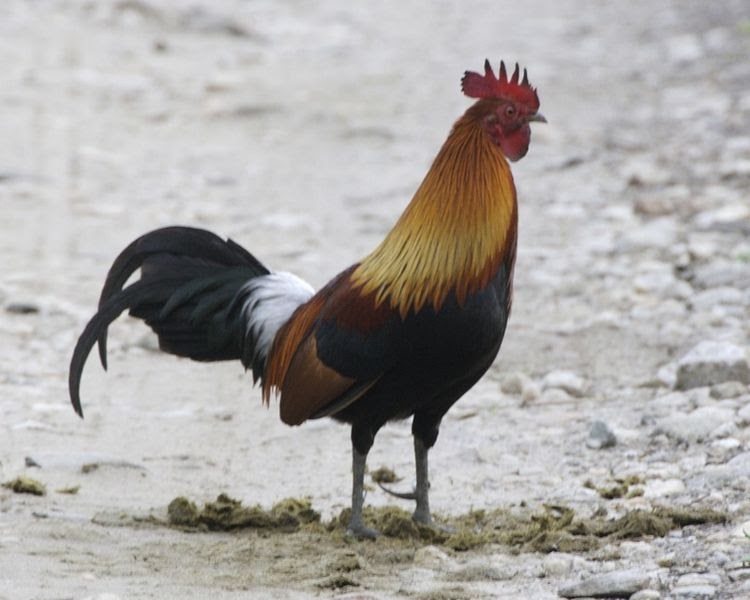
However, I recently read a really neat article in Smithsonian Magazine: How The Chicken Conquered the World which has me rethinking my attitude towards our Colonel. The chicken's lineage it turns out stretches back an estimated 10,000  years to the  Red Jungle Fowl (Gallus gallus) of Southeast Asia.

Red Jungle Fowl (Gallus gallus). Source:Wikipedia.com
In the wild, the rooster acts like many other male critters, defending his harem, fighting other males and declaring himself the baddest of the bad to all that can hear. One interesting point about the chicken is that the hormone that causes most creatures to only mate at a certain time of year seems to be suppressed. This means the hens can reproduce (lay eggs) year round as opposed to say turkey and geese which only mate in the spring. This also means that the lucky rooster has to mate his hens year round to keep them fertilized and thus build the flock. This is probably a key to why the chicken was domesticated long before other fowl, since their eggs were available all year long. The eggs it seems were utilized long before their meat, which didn't become popular until relatively recently.
Another item I found fascinating is that long ago Roman armies would travel with a rooster, or cock as they are historically known. The cock was observed before a battle, and only if he had a good appetite did the army go into battle believing a victory was likely.
The rooster's courage was so revered in fact, that where it is still practiced cock fighting is the oldest form of sport. While in the US it is considered inhumane and cruel, in many places cock fighting is a traditional sport, and the victorious rooster is celebrated.
Like I said, it's a neat article and worth the time to read, but enough about the ancient chicken. Today the chicken is prized for it's mild meat and it's ability to lay eggs consistantly. Also the chicken produces more meat per pound of feed than almost any other domestic livestock, save only the rabbit. We have adapted the chicken to our needs so entirely that even in "free range" chicken houses often the birds don't range at all, choosing instead to remain by the feeder waiting for the next timer controlled ration.
So, after all that when I go outside and see our hens foraging about the yard, clucking with joy at the discovery of a worm or seed, and watching the rooster mount the compost pile to crow for the umpteenth time in a row, I am filled with pride. For these chickens, after all these centuries of domestication and human manipulation still know what it means to be a chicken. Could they survive in the wild? Probably not, but at least now when the Colonel puffs his neck and dances at my legs I have to stop and smile because, after all, he is doing exactly what he should be doing. Acting like a rooster.
The Dude: Colonel Sanders with his hens.

KJ

Wednesday, January 11, 2012

Two steps forward and one step back

The week has been a little bumpy around here, just when things seemed to be going really well we've had some unfortunate set backs.
In the coop, our hens have been doing great. Since the winter has been mild thus far, they are super active and are getting lots of sunny winter afternoons foraging in the dormant garden. We are gathering a dozen eggs a day regularly and have developed a great group of friends and neighbors who gladly purchase or trade for our eggs every week. The egg money has been covering the cost of feed and things seemed to be just grand.
In the hives, things seemed to be going well also. Both of the colonies are still alive despite my lack of knowledge and the many opportunities to fail. The bees have been making use of the sugar I provided (blog post: mid-december part-2: emergency feeding) and and appear to be wintering well.
Then came the setbacks. We were hit with a nasty wind storm one night which blew the top off one of the bee hives. In hindsight, it's obvious that I should have had rocks on the lids, and I had also mentioned building a windbreak which had not gotten done. I was at work when Whit called to tell me the hive was open, so more than likely it was that way most of the night and all the morning. Bees cluster to keep the queen 92 degrees f. and death from exposure is very common in cold climates like ours. That's why experienced beekeepers never open their hives when it's below 50 f. (the temp when bees can no longer fly). That night it was in the teens and it was in the low 30's when I got home. The other major concern in the winter is moisture. High humidity in a hive is a bad thing and can lead to a bacterial disease called Nosema. When a hive gets Nosema the likely hood is the hive will die without an aggressive treatment with chemicals. So needless to say, the cold wet condition I found my hive in that day was very concerning. I rushed to put the lid back on, and fashioned a lamp in the hive for the afternoon to try and warm/dry things a bit. When I removed the lamp that evening, there were bees were moving about, but there were also many dead bodies scattered on the top of the frames. Since then I've seen bees moving about by peeking in the cracks but have not had a good day to look in and check on them. From what I've read, a shock like that is not always a death blow, but certainly didn't help anything. Of course now there are rocks on the lids and a straw bale wind break in place... learning is hard sometimes.  
As I was still kicking my self over the hive incident, Whit came home one afternoon and found a dead hen. One of our araucanas we called "Grousie" (because she looked like a ruffed grouse as a chick) was laying dead on the coop floor. We looked her over but could not find any marks or anything out of place at all. The coop and run had not been broken into and there was no blood. She looked for all the world like she was laying on the floor asleep. After a sad good bye, we started looking into why this could have happened. There are actually a number of ways a chicken can die unexpectedly from heart attack to calcium over douse. Since we believe little Grousie was a new layer and her vent appeared swollen, Whitney suspects an impaction of the oviduct, a birthing complication you could say. Chicken reproduction is really fascinating, check out this great blog: http://eggcartonlabels.blogspot.com/ how hens makes eggs  if your interested. This is our best guess, but for now the death remains an un-solved mystery.
Grousie is the furthest rear hen in the above photo, we'll miss her around the coop.
We remain positive of course, speed bumps like these are all apart of the journey.
I hope my next post brings better news. Until next time.
KJ

Saturday, December 17, 2011

Mid December- Part 1: An Egg update

So what's going on around here the week before Christmas?
After adjusting to the newness of snow, the chickens are doing really well and enjoy getting out in the yard every chance they get. One of us goes out every morning around sun-up to check the girls and open the coop, and by that time they are very ready to be up and about. The cold doesn't seem to bother them a bit, only the really windy days keep them cooped up. We've opened up the chicken run to the garden and they really like pecking and scratching around and in the garden beds.
The coop is a much calmer place since we removed the two other roosters, these days it's downright pleasant. The hens are laying about a dozen eggs a day thanks to the heat lamp which keeps them warm and lighted despite the cold short days. Some people say that the hens need a break in the winter, but we've yet to read a good reason for that and ours seem to be doing fine. We did notice that there were very few hens using the upper boxes, so we added a perch to give them a place to climb in. That seems to have fixed the problem for the most part.
We collect eggs once or twice a day, often reaching under the hens to get them. The hens are generally agreeable to this, although at times one will let you know she's not happy with a sharp peck.
Selling the eggs is going very well too.  Thank you very much to everybody that has bought eggs from us! Lately we've been able to buy chicken feed and scratch using the egg money which was a goal of ours. 
 As near as I can tell, the honey bees are wintering well also. I check them every few days by putting my ear to the box and giving it a quick tap. The bees buzz in response and then go back to their business. What is their business? Keeping the queen warm! The colony forms a tight ball and everybody works together to make heat. The ball moves gradually as the bees consume honey for energy and cycle from the inside to the outside of the ball. Both colonies have access to sugar syrup, but the consumption has gone way down since the fall. Since it's hard for the bees to move far this time of year, I need to switch from the syrup to sugar cakes or dry sugar feeding for the winter. I need to check on them, but hesitate to open the hives because exposure to the cold can kill them. In a well established hive there is enough honey that you don't need to feed, but mine are not that well prepared since we got a late start. 
 Feeding sugar cakes involves making hard sugar rich patties and placing them in the hive, while feeding dry sugar can be done by placing newspaper on the frames and pouring a few pounds of sugar on newspaper. The humidity in the hive will cause the sugar to harden and form a cake.
 I found a very good beekeeping blog with lots of pictures and how to's at http://mudsongs.org/. These guys keep a very neat blog devoted to beekeeping in St. John's, Newfoundland. I am encouraged by reading about their success in a climate worse than mine. Last year they made and fed sugar cakes and I may need to do the same. Mudsongs.org/making-candy-cakes.
Also, http://www.beesource.com/ has a good (lengthy) USDA text explanation of winter feeding at http://www.beesource.com/resources/usda/supplemental-feeding-of-honey-bee-colonies/

I'll keep you posted on my bee's progress and what I decide to do about feeding.
Until then, Happy Holidays to everybody, Merry Christmas, keep warm and stay safe. 
KJ 

Tuesday, November 22, 2011

Snowbirds and Blue Eggs

These past couple of weeks came as a surprise to the chickens, as this has been their first taste of winter. With daytime highs only in the mid teens and a healthy 6" of snow on the ground the girls turned quickly in to coop potatoes. It wasn't until the weather warmed up some and I shoveled a bare spot in the run that they would venture out. The weather has been a learning process for us too, as the shortened daylight and cold weather meant less eggs and frozen water. We overcame these obstacles by adding a heat lamp to the coop and a heated stand for the water. Now we are back up to 10 or 11 eggs a day, and have recently celebrated the first of our Araucana eggs!


These are the smaller multi colored hens that have been the slowest to develop. They are special because each has a unique coloring and they lay eggs that can vary between blue and green.
Besides trying to keep the chickens from freezing, we have been very busy butchering the two mule deer and one whitetail that we got this year. More on that coming later.
Until then we hope everybody has a happy, warm and safe Thanksgiving!
Kyle and Whit. 

Wednesday, October 26, 2011

The first $2.50

This was truly a big day. We've sold our first dozen eggs!

We're now gathering six eggs a day, and every other day or so a new hen starts. By next week we should be up to a dozen a day. So, for the first time we've sold eggs. One of Whitney's coworkers bought the lucky dozen, for the sum of $2.50.


The egg money jar

Why $2.50?  We're not trying to get rich here, but the chickens didn't need to be a money sink either.  We believe there is a economic side of hobby farming, it should be able to provide and support it's self. Not buying eggs will save us money, but chicken feed ain't free! From the beginning our idea for the chickens was that they should pay for their own feed. $2.50 is the going price locally and should pay for feed and and fresh bedding every few months. 
And so just like that, after months of planning and waiting, we are in the egg business!

Sunday, September 25, 2011

The First Egg!

Today was a big day!
While Whitney was busy canning salsa and plum preserves in the kitchen, one of the hens was hard at work in the chicken coop. I  was outside at the time splitting wood and started hearing the tell tale noises coming from the coop. I got Whitney and we went out to investigate. What we found out there was pretty amazing. One hen, a little barred rock, was sitting in a nesting box. Her beak was open and she looked more than a little upset. She was clucking loudly, but even louder was the rooster, pacing and squwacking in front of her. Ridiculous as it sounds, it really looked like a nervous father waiting for a birth! This show went on for quite a while, so after a time we went back to what we were doing and left the chickens in peace.

After a while things got quiet and we went to take a look. At last there it was! Our flock's first egg!
It's pretty small, and may not be good to eat, but it's an egg and our first. Whitney figured it out and the chickens are 18 weeks old now. Seems amazing that just about 4.5 months ago these little fuzz balls showed up in the mail, and now we have laying hens (well, one at least).  We're pretty dang excited.


So much so in fact we decided to open a bottle of Mead (honey wine) to celebrate the occasion. If you've never tried Mead, I highly recommend it. Mead is a very old drink that is made primarily of honey water and yeast. The website says that mead predates grape wine by one thousand years! This bottle came from a Montana mead maker and features Montana honey. Check out http://hiddenlegendwinery.com/ 
And there they are, the happy chicken farmer and not quite as happy hen. Soon all the other hens will follow along and have eggs, but for us this hen will always be special.
That's all for now, I hope you all had a wonderful day. KJ