Showing posts with label Roosters. Show all posts

Monday, September 10, 2012

Chicken Integration

If you recall from earlier posts like The halfway house aka chicken tractor and chick love, Whitney and I raised 5 more chickens this year. These Silver Laced Wyandottes came to us as day old chicks and we brooded them in the house until they were old enough to go outside. They lived in the chicken tractor for several weeks while becoming accustomed to the outside world. After they became comfortable, we began opening the door in the afternoons so that the pullets could roam the yard like the hens do. But even though they were all out together, the two groups would not mix. They were two groups tolerant of each other but not interested in meeting. Eventually the pullets became too big for the chicken tractor, so it was time to move them into the coop.
The Five Pullets
I guess I thought Whitney would just chicken whisper them right into the hen house, but it didn't exactly work that way. It turned out more like a game of Chase the Chicken every night for a week. The books all say that it is as simple as placing the pullets in the coop at night, and the next morning they will wake up knowing that's home. I'll tell you how it went for us: One night Whitney and I moved the pullets one at a time into the coop and placed them on the roost. The next morning, when I opened the door to the chicken yard, the pullets tumbled out and hid in the corner. The hens scratched and pecked like normal, but the pullets continued to huddle off on the side. That afternoon we opened the door to the big yard and the pullets ran back to the chicken tractor! We rounded them up and got them back in the coop, but they were clearly not happy about it. For about a week every time we opened the door, the pullets ran out to return to the their old home. It was sad, and we even worried that they might not be eating but after several rounds of chicken wrangling they did start returning to the coop at night. It's taken a while but I'm happy to say that the flock is now fully integrated. Sure the hens have a pecking order and the youngsters are not yet on the top roost, but they aren't a separate flock either.

The Integrated Flock
To top the news, this week Whitney found a couple mini eggs in the nesting boxes, suggesting our little Wyandottes have started laying! So, it's official we've got 19 layers and 1 rooster (although one of the Wyandottes is showing some rooster-like tendencies, more on that later).
Sometime soon we will try honey extracting for the first time, so stay tuned for that.
Until next time, as always, thanks for stopping by.
KJ

Saturday, June 9, 2012

Celebrating the wild side of chickens

Our rooster Colonel Sanders is starting to show his heritage. More and more these days he is acting like a rooster, crowing and strutting constantly, "servicing" the hens every few minutes and at times pecking and flapping at our legs. His antics have cost him some friends, one of our neighbors even blogged about her bad encounter with the Colonel (when they visited our chicken coop while we were out of town). Whitney generally talks softly to him when he's like this and picks him up to calm him. Together they walk around the yard, while she talks softly and pretty soon his eyes are shut and she grins at me with the napping bird in her arms. My own reaction to his chicken dance is a little less compassionate: generally I tell him to buzz off and keep going about my business.
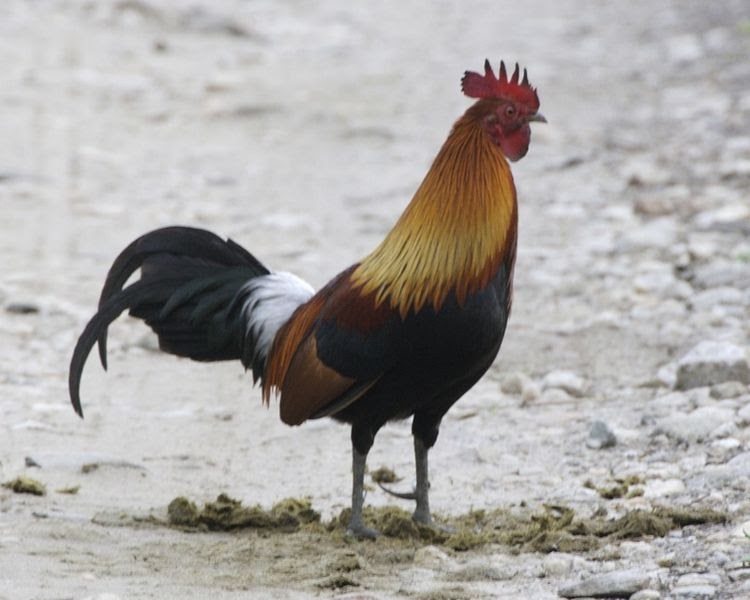
However, I recently read a really neat article in Smithsonian Magazine: How The Chicken Conquered the World which has me rethinking my attitude towards our Colonel. The chicken's lineage it turns out stretches back an estimated 10,000  years to the  Red Jungle Fowl (Gallus gallus) of Southeast Asia.

Red Jungle Fowl (Gallus gallus). Source:Wikipedia.com
In the wild, the rooster acts like many other male critters, defending his harem, fighting other males and declaring himself the baddest of the bad to all that can hear. One interesting point about the chicken is that the hormone that causes most creatures to only mate at a certain time of year seems to be suppressed. This means the hens can reproduce (lay eggs) year round as opposed to say turkey and geese which only mate in the spring. This also means that the lucky rooster has to mate his hens year round to keep them fertilized and thus build the flock. This is probably a key to why the chicken was domesticated long before other fowl, since their eggs were available all year long. The eggs it seems were utilized long before their meat, which didn't become popular until relatively recently.
Another item I found fascinating is that long ago Roman armies would travel with a rooster, or cock as they are historically known. The cock was observed before a battle, and only if he had a good appetite did the army go into battle believing a victory was likely.
The rooster's courage was so revered in fact, that where it is still practiced cock fighting is the oldest form of sport. While in the US it is considered inhumane and cruel, in many places cock fighting is a traditional sport, and the victorious rooster is celebrated.
Like I said, it's a neat article and worth the time to read, but enough about the ancient chicken. Today the chicken is prized for it's mild meat and it's ability to lay eggs consistantly. Also the chicken produces more meat per pound of feed than almost any other domestic livestock, save only the rabbit. We have adapted the chicken to our needs so entirely that even in "free range" chicken houses often the birds don't range at all, choosing instead to remain by the feeder waiting for the next timer controlled ration.
So, after all that when I go outside and see our hens foraging about the yard, clucking with joy at the discovery of a worm or seed, and watching the rooster mount the compost pile to crow for the umpteenth time in a row, I am filled with pride. For these chickens, after all these centuries of domestication and human manipulation still know what it means to be a chicken. Could they survive in the wild? Probably not, but at least now when the Colonel puffs his neck and dances at my legs I have to stop and smile because, after all, he is doing exactly what he should be doing. Acting like a rooster.
The Dude: Colonel Sanders with his hens.

KJ

Tuesday, November 8, 2011

3 Roosters is 2 too many

Today was a sad day for our flock. Two of our "girls" had to move on.
For a while now we've had a couple larger chickens that we were watching, hoping they'd be hens. Because there was supposed to be two breeds of black and white chickens, our hope was that one breed was significantly larger than the other, and that we only had two of that large breed. It seemed reasonable. Also, while the Colonel has been crowing and acting quite rooster like for months, these other big birds were rather docile. But sadly, recently these other two have shown their true rooster natures. They grew combs and spurs and began harassing the hens. This apparently caused Colonel to harass the hens with renewed vigor. All of a sudden the chicken yard was getting pretty out of hand, and some of the hens were getting pecked to the point of bleeding. This can become a real problem because chickens are very attracted to red and blood can cause chickens to peck one another to death.
So as a solution first we thought maybe somebody local would like a 4H rooster. Youngsters often show roosters at the fair and we know a few families that do, but they were not interested. Next we hoped somebody may just like to have a rooster, but that turned out to be a long shot also. Finally it became clear that our two barred rock roosters were enough of a problem, they were leaving one way or another. While this was going on, we had also heard about the recent trend of using chicken feathers for earrings and decorating girl's hair. Chicken feathers are quite valuable it turns out, and one of our local hair stylists has gotten in to feather dyeing. Whitney and her are good friends, and they will use these feathers to try some different earrings and things.
I asked around and found a friend that was interested in having the meat, in exchange for skinning the birds. The usable part of the skin is called the saddle, and extends from the back of the head to the top of the vent (Google it if your not sure what a chicken's vent is).  He has a lot of experience with this because at one time he raised chickens for meat and feathers, although at that time the feathers were for fly fishing flies. This option worked well for us since we weren't prepared to butcher and skin our roosters, but didn't want to see the birds wasted. The meat for a clean saddle was a fair trade.
So, tonight I went and learned how to dispatch a chicken. This didn't turn out to be nearly as traumatic as you may imagine. None of the chopping block and cleaver and headless chickens running around that I was imagining. A simple, quiet slit with a small kitchen knife while holding the rooster upside down was all it took. A few seconds later and they were done.
Sad as it is, that turned out to be the best option. The meat will be used, the feathers will be used, the hens can take a break and we don't have to feed extra mouths. Sometimes it's not fun but as animal owners we had an obligation to do the right thing for the hens. Also if we are going to take these chickens seriously at all, we can't feed extra birds for no reason.
On a lighter note, the hens are producing 6 - 8 eggs a day now. And as it is now honest to gosh winter (19 degrees the other day) we've put a heat light in the coop to keep the water from freezing. This should help with our egg production to, as we should be closer to a dozen a day and right now demand is exceeding supply!
Thanks for reading. KJ