Showing posts with label Colonel Sanders. Show all posts

Saturday, June 9, 2012

Celebrating the wild side of chickens

Our rooster Colonel Sanders is starting to show his heritage. More and more these days he is acting like a rooster, crowing and strutting constantly, "servicing" the hens every few minutes and at times pecking and flapping at our legs. His antics have cost him some friends, one of our neighbors even blogged about her bad encounter with the Colonel (when they visited our chicken coop while we were out of town). Whitney generally talks softly to him when he's like this and picks him up to calm him. Together they walk around the yard, while she talks softly and pretty soon his eyes are shut and she grins at me with the napping bird in her arms. My own reaction to his chicken dance is a little less compassionate: generally I tell him to buzz off and keep going about my business.
However, I recently read a really neat article in Smithsonian Magazine: How The Chicken Conquered the World which has me rethinking my attitude towards our Colonel. The chicken's lineage it turns out stretches back an estimated 10,000  years to the  Red Jungle Fowl (Gallus gallus) of Southeast Asia.
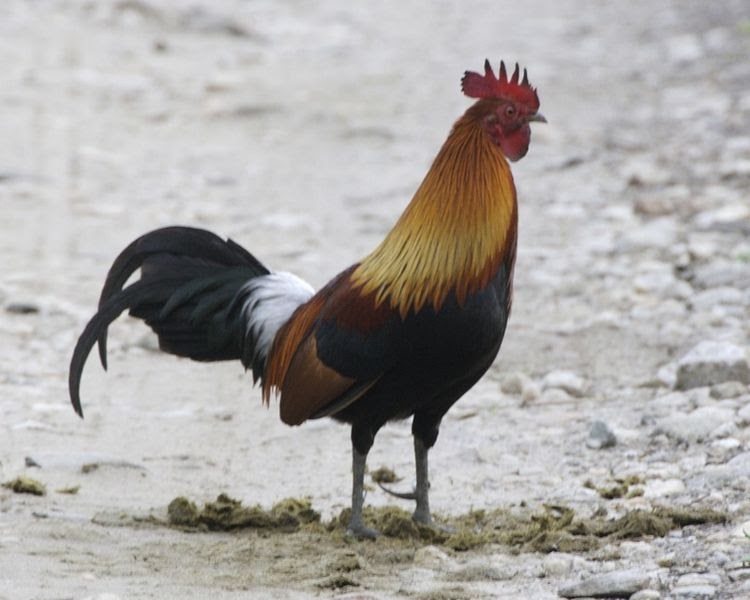
Red Jungle Fowl (Gallus gallus). Source:Wikipedia.com
In the wild, the rooster acts like many other male critters, defending his harem, fighting other males and declaring himself the baddest of the bad to all that can hear. One interesting point about the chicken is that the hormone that causes most creatures to only mate at a certain time of year seems to be suppressed. This means the hens can reproduce (lay eggs) year round as opposed to say turkey and geese which only mate in the spring. This also means that the lucky rooster has to mate his hens year round to keep them fertilized and thus build the flock. This is probably a key to why the chicken was domesticated long before other fowl, since their eggs were available all year long. The eggs it seems were utilized long before their meat, which didn't become popular until relatively recently.
Another item I found fascinating is that long ago Roman armies would travel with a rooster, or cock as they are historically known. The cock was observed before a battle, and only if he had a good appetite did the army go into battle believing a victory was likely.
The rooster's courage was so revered in fact, that where it is still practiced cock fighting is the oldest form of sport. While in the US it is considered inhumane and cruel, in many places cock fighting is a traditional sport, and the victorious rooster is celebrated.
Like I said, it's a neat article and worth the time to read, but enough about the ancient chicken. Today the chicken is prized for it's mild meat and it's ability to lay eggs consistantly. Also the chicken produces more meat per pound of feed than almost any other domestic livestock, save only the rabbit. We have adapted the chicken to our needs so entirely that even in "free range" chicken houses often the birds don't range at all, choosing instead to remain by the feeder waiting for the next timer controlled ration.
So, after all that when I go outside and see our hens foraging about the yard, clucking with joy at the discovery of a worm or seed, and watching the rooster mount the compost pile to crow for the umpteenth time in a row, I am filled with pride. For these chickens, after all these centuries of domestication and human manipulation still know what it means to be a chicken. Could they survive in the wild? Probably not, but at least now when the Colonel puffs his neck and dances at my legs I have to stop and smile because, after all, he is doing exactly what he should be doing. Acting like a rooster.
The Dude: Colonel Sanders with his hens.

KJ

Tuesday, November 22, 2011

Snowbirds and Blue Eggs

These past couple of weeks came as a surprise to the chickens, as this has been their first taste of winter. With daytime highs only in the mid teens and a healthy 6" of snow on the ground the girls turned quickly in to coop potatoes. It wasn't until the weather warmed up some and I shoveled a bare spot in the run that they would venture out. The weather has been a learning process for us too, as the shortened daylight and cold weather meant less eggs and frozen water. We overcame these obstacles by adding a heat lamp to the coop and a heated stand for the water. Now we are back up to 10 or 11 eggs a day, and have recently celebrated the first of our Araucana eggs!


These are the smaller multi colored hens that have been the slowest to develop. They are special because each has a unique coloring and they lay eggs that can vary between blue and green.
Besides trying to keep the chickens from freezing, we have been very busy butchering the two mule deer and one whitetail that we got this year. More on that coming later.
Until then we hope everybody has a happy, warm and safe Thanksgiving!
Kyle and Whit. 

Sunday, September 18, 2011

Pickling Beets and Waiting For Eggs

To our surprise, our hens who are now four months old, have yet to start laying. Some of our friends who got their chickens at the same time as us have already been getting eggs but we have not. So in the mean time were just waiting on eggs, a blessing in disguise I bet, because soon there will be a flow of eggs we'll have to deal with ready or not.
That's not to say that the hens aren't working, most evenings they are out in the yard foraging for grasshoppers and other goodies and our sociable rooster Colonel Sanders is never far away when we are outside. 


One of this weekend's jobs was pickling beets. These beauties are Detroit Kings and Wonder Talls. Whitney planted them after the last frost and by planting in two rounds we got two harvests. This is the last of them, about 16 LBS. So while the UM Grizzlies took on the E. Washington Eagles, we set about harvesting and washing beets.


 To many it seems just the mention of the word Beet is enough to induce an upturned nose and ideas of bad flavors, but these people I'd say have never tried home made pickled beets. One of the most picky people I know (Bailey) tried them this summer and after a sniff and a doubtful look, deemed them quite good!
After the initial washing and trimming, the beets are boiled skinned and sliced.

The pickling solution is boiled while you are preparing the beets, then the beets are packed into jars and the solution poured in. The jars are placed in a hot water bath and boiled. After about 30 min. the jars come out and are set on the counter. As they cool, the jars seal and complete the canning process. 

I just love the color, and knowing we have beets for a year!
About this time the Griz were beating the Eagles, a nice topper to the day and no small feat: the E. W. Eagles were the FCS National Champions last year!
After all that it was time to eat something, so we turned to the zucc's and carrots we had also picked, and added some new potatoes from the spud box.


These got chopped and roasted in the oven and together with some antelope dogs from the freezer made a delicious home grown meal.
Sadly, that was about the end of our antelope.  I'll miss enjoying the sweet, tender meat and remembering our hunting trips to get them. In the end it is a good thing really because they were nearly two years old, and meat shouldn't be kept any longer than that. And, now I get to plan our next trip to Antelope Country!!
That's all for now.

KJ